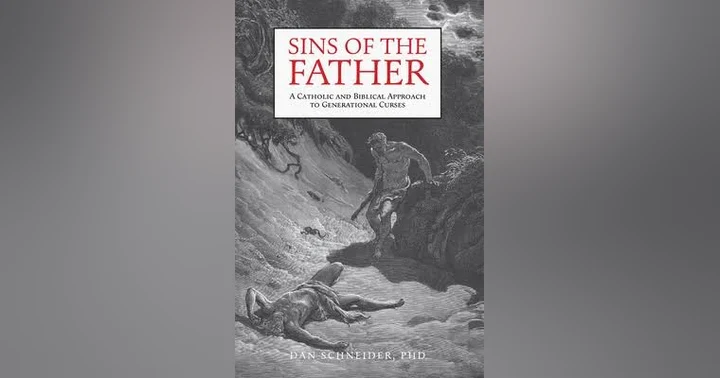
Ep 201 - Your Sins Have a Price Tag And Your Kids Might Be Paying It with Dr. Dan Schneider


What if the chaos in your family isn't random? What if the patterns of addiction, broken relationships, and spiritual emptiness running through your bloodline have a real theological explanation?
In this episode, James speaks with Dr. Dan Schneider to break open one of the most misunderstood topics in the Church today: generational sin and familial curses.
Dr. Dan unpacks his new book Sins of the Father: A Catholic and Biblical Approach to Generational Curses, walking through what the Church actually teaches about how a father's sins affect his children. The answer is harder to hear than most men want. Because it puts the weight squarely back where it belongs: on you.
We cover why healing Masses for "the family tree" get the theology wrong, what it actually means when God says He will "visit the iniquities of the fathers upon the children," why the confessional is where warriors go to get rebuilt, and what God is going to actually ask you when you stand before Him.
The challenge for every man listening: Stop blaming your ancestors for your struggles and start building the kind of legacy your children and grandchildren will point to as the day the curse ended. What are you giving your family?
The ancient weapons are still the best ones. Go to Confession. Offer Mass for the dead. Fast. Do penance. Die to yourself. That's it.
BOOK REFERENCED: Sins of the Father: A Catholic and Biblical Approach to Generational Curses by Dr. Dan Schneider
POWERFUL QUOTES FROM THIS EPISODE:
- "The confessional is where warriors go to get rebuilt. We serve a King — the King of Kings and Lord of Lords — and we serve Him in and through our families." — Dr. Dan Schneider
- "You want to be a man? Hand yourself over. Die to yourself so that Jesus Christ can live and reign." — Dr. Dan Schneider
- "God's not going to say, 'Hey James, great podcast — how many likes did you get?' He's going to say, 'Give me your wife, your kids, your grandkids. What did you do? Did you pass on the faith?'" — Dr. Dan Schneider
Thank you for your prayers and support!
Consider supporting the podcast on our Buy Me A Coffee page to help grow the show to reach as many men as possible!
Subscribe to our YouTube page
Check out our website
Get delicious coffee from Mystic Monk Coffee
Download TAN Digital to access the incredible TAN Library! Use code 'MANLYCATHOLIC' to get 50% OFF your subscription!
Contact us at themanlycatholic@gmail.com
James Caldwell: This is the Manly Catholic, the podcast that calls you out of the shadows and into the fight. Here we forge men into warriors for Christ, husbands, fathers and leaders who refuse to kneel to the modern world's lies. No more passivity, no more excuses, no more lukewarm faith. This is your battle cry, your call to arms. The time for weakness is over. It's time to fight. Welcome to the Manly Catholic. Let's get to work. Hello all, welcome back to another episode of The Manly Catholic. This is James, your host and with me once again, Dr. Dan, the man Schneider. Dr. Dan, welcome back to The Manly Catholic podcast. Great to be back. Good to see you again, my friend. Another book written. That means another episode is coming your way. Tonight, we're talking about a pretty heavy hitter, I would say. It is right here, brought to you by Tan Books. It is called Sins of the Father, a Catholic. and biblical approach to generational curses. I was telling Dan before, I've gotten this book for about two months and I still haven't finished it. But I've highlighted pretty much every page, gone to the footnotes. I think it's something, it's a very important topic. I think that is a topic that probably a lot of people misunderstand or don't understand at all. So I'm really excited to dive into this with you, Dr. Dan. But before we dive into this topic, I think the St. Michael prayer would be very appropriate. Absolutely. the Son and the Holy Spirit, amen. Saint Michael the Archangel, defend us in battle. Be our protection against the wickedness and snares of the devil. May God rebuke him, we humbly pray. And do thou prince of the heavenly hosts by the power of God cast in hell, Satan and all evil spirits who prowl about the world seeking the ruin of souls. Amen. Father, Son and the Holy Spirit. Amen. Dr. Dan, let's start with a very open-ended question. What prompted you or what? I guess, led you to write a book like this. Did you just felt like it was a need? Do you feel like it was kind of like I mentioned, it's just a very misunderstood topic? What kind of led you in this direction to tackle? Yeah, was part of it began with just field experience, working cases and seeing children afflicted, even infants. Anyone that works in the field, even from various backgrounds and modalities, the way you do this in the field of exorcism or deliverance, there is something recognizable in some sort of familial connection with a lot of our our defects, our sins, our vices. And so I noticed that like others, seeing these patterns, you know, I'm just a retired, not retired, but I'm just an old cavalry scout, former cavalry scout. And so I just seen these patterns. That was one. And then I was writing the follow-up book to the, the Libra Cristo manual and, uh, and, and I had a chapter on generational curses and Father Ripper and I were talking and he said, you know, we really need to flesh this out. more in detail, a little fuller. I said, okay, well, I'll just turn it into a manuscript. I just started, the more I researched, a section became a chapter and a chapter just became its own book. And part of it was there's a lot of misunderstanding. And so you've got the Spanish bishops conference, the Polish bishops, the French bishops have come out with statements on this topic because a lot of it is misconstrued and misunderstood. And we've kind of We've all been to Mass where the Mass that day is for the healing of the family tree of the Garcia family, Jones family, whatever. That's just not Catholic theology. So I started digging more deeply into Scripture. Okay, what's the Scripture say? How does Scripture square with, okay, my experience? Okay, and then it doesn't matter my experience or Scripture, what do the fathers say? And so I just started going into researching it. So I started looking at the topic and sure enough, I discovered St. Augustine. and his debate with Julian of Aklonema, Augustine's a doctor of grace, and gave us the dogma of original sin. And so he actually uses this concept of the punishment of experience, not the sin, but the effect of the sin carrying down to the children against the arguments of those who denied original sin. So I wanted to approach it from that perspective as a biblical scholar and also a patristic scholar, and then into St. Thomas, where we see how St. Thomas receives and builds upon. but Augustine largely and but others as well have said, and really comes down to why does God allow the demon to afflict us? Why does God allow us to suffer? That's kind of the crux of the question. Yeah, and even in the terms, I guess I think it's important to define terms, especially because there are some nuances within this topic as well. So as generational sin or a familiar curse, I guess let's just define those and then we'll go from there. So what is a generational I guess. So the way it came in originally from Protestantism through a missionary named Kenneth McCall, a charismatic Protestant missionary who was a psychologist. And so he was kind of blending his experience as a psychologist form in Carl Jung and that type of psychology and archetypes and the imaginative approach and imagination, these other things, and combining with his experience in the mission work. And so he started to see these connections and start And then he would see these ties and the sin is transgenerational or intergenerational. so you have to have, his, you know, they had a Protestant liturgy of some kind, Eucharist of some kind that would sever the chains that was connecting the current person and forcing them to suffer. And they sever the chains and now they no longer suffer. That's not the Catholic perspective. And so that, that is so an idea we have to do. That's why I started off in the opening. Let's define our terms on by generational. We don't think of, there's only one sin that's generated and that's original sin. That is one that is as an active generation in a sense. Every other, and so generational is not in that sense. If I generate, this is an error called traducianism. It's an early church heresy. If I generated a sin in my children, that mean I generated their soul. And therefore I gave them their soul and my sin is personal to them and they now carry it forth. And that's not what the church teaches. or the fathers. so, this is where it kind of came in and gets picked up through the Charismatic Renewal and Catholic circles. So, by generational, if you look at the definition, let's look at what does it mean by generational? What does it mean by curse? By generational, we're not talking an active type of generating, but a passive in the sense of inherited wealth, right? So, if you and I were Kardashians, we wouldn't be podcasting and writing books. We'd be chilling out on the beach with our soulmate, right? No, we would still be out there evangelizing, but you know what I'm saying? It's inherited. It's a guilt that is inherited. This is the way, if I went to Augustine and said, let's talk about intergenerational sin, he would say, what are you talking about? You sound palatial to me, knock it off. But if you said, let's talk about a guilt that is inherited involuntary by curious punishment for the effect of the sins of the father, who was all, mean inherited guilt. You got it, let's go there because this is embedded into divine justice and divine mercy, both. So inherited is something. generational is inherited. And we talk about a curse, there's active curses and we're very, you know, we're seeing more and more of this today with Satan, Satan, worshipers and satanic cults and Freemasonry and other, either Luciferian or satanic organizations that are doing active curses where they use matter and eggs and sage and even blood and pigs and all these other weird stuff these guys do, this is whatever they do. It's an active engagement with the preternatural order. to bring about a curse, which is the opposite effect of blessing. And that's not what we're talking about either. generational, I mean, by curse, we're talking about the privation that comes through blessing, a privation of what should be present in that family. And that is a privation of protection and provision. That's what a father and a mother are called by office. The father is head of household, the mother is also having authority over the children. they are called to provide and to protect. Benedict the 16th used the words of Jesus to Peter on the Sea of Tiberias to explain what it means to have an office of governance. And he's talking about the office of priest and bishop, but it applies also to us fathers and mothers. And he says, my lambs, tend my sheep. Do you love me? Feed my lambs, tend my sheep. And so to provide and to protect, these are the two ends of the authority structure. And so it's not like you get on an airplane and somebody sneezes and it's like, I just got the sin of fornication. It's not random. It works along the familial construction. So this is how Thomas takes Augustine a step further and says, inasmuch as the children are the property, part of the bodily goods of the father, they can affect, they can suffer the effect of the father's sins because the Catechism, says, for example, in Catechism 1142, 1472, it says, to understand the doctrine and practice of the Church of Indulgences, this is topic. more than a year in the indulgences, it's necessary to understand that sin has a double consequence. Grave sin deprives us of communion with God, it makes us incapable of eternal life, the privation of which is called the eternal punishment of sin. But every sin, even venial sin, entails an unhealthy attachment to creatures, which must be purified either here on earth or after death in a state called purgatory. This purification flows from what is called the temporal punishment of sin. These two punishments must not be seen as a vengeance inflicted by God. but a conversion which proceeds from a fervent charity, et cetera. So sin is a double consequence. And so we see embedded into the original sin an archetype for all sin. Adam and Eve commit the sin, the original sin. They are deprived of original justice. They lose the state of grace. They alone pay the punishment, each individually. Adam and Eve individually are punished. They lose the state of grace, original justice or holiness. They lose original innocence. They lose original integrity. Their entire faculties are now disordered. So they lose these original goods, which are all spiritual. And there's a punishment for that sin. But there's also a temporal effect, and they're driven from the garden. And the Catechism elsewhere says that that sin has a personal and a communal effect. You commit, this is largely a masculine audience. A man thinks if I commit the sin of masturbation and impurity that it's just me, it doesn't hurt anybody else. It does. Sin has a communal effect. Sin creates an alienation between you and God, you and others around you, and even your very self. And so the effect of the sin, the temporal effect, Adam and Eve are driven from the garden. That's part of the temporal punishment, but the effect carries into the communal family line. and Cain kills Abel. there you see sin has this double consequence. So Thomas brings it back and says there's two effects of sin and there's two punishments. There's a penal punishment that each individual person pays the price for. has to be punished for that sin. And then there's a temporal effect of what he calls a medicinal effect to help make satisfaction. Think about the image of Lady Justice, right? And the image of Lady Justice is carrying the scales. The word justice, deque, means means balance. And so sin creates an imbalance and satisfaction must be made for that sin. This is Catholic teaching and we don't like to hear that, that we think subjectively, I'm sorry I didn't really mean it and there's no therefore no effect of my sin and that's just simply not true. That satisfaction must be made. Coffee and prayer, it's the perfect blend. Mystic Monk coffee isn't just another cup of coffee. It's handcrafted by the Carmelite monks of Wyoming. roasted with care and infused with prayer. Whether you're starting your morning or fueling your day, Mystic Monk Coffee has you covered. It offers rich, bold flavors that are as divine as their mission. By choosing Mystic Monk, you're not just enjoying exceptional coffee, but you're supporting a community of monks dedicated to their work, to prayer, and to the church. It's coffee with a cause. So what are you waiting for? Visit mysticmonkcoffee.com and experience the brew that's fueling faith and flavor. I think to what really helped me understand this, I don't know if this was in your book, Dan, or if I heard you talk about on the podcast and you make it because this concept is I guess it's difficult to understand to an extent. I think you made the reference or the example of like, okay, so say you have a dad who, you know, provides to the family is the primary provider. And he decides to go out to a bar and drink and then he gets and then he kills someone he goes home and he drinks and he gets arrested. And then who is that going to affect? Like, of course it's going to affect him, but it's going to affect his wife and his children. Cause now they don't have a primary provider, their father's in jail, their husband's in jail. And now all these negative consequences of his decision to do these couple things, which ended up separating himself from the family. I mean, all these negative consequences come from that. Is that similar to what you're talking about? Or is that sort of a different- Yeah, exactly right. What, what, what, what, what, know, the analogy, a good analogy is, you know, a father or even analogy that I use in the book is a truck driver. So he's a truck driver. goes on his way home. He pulls into a bar and decides, ah, just a, just one. And then he has two and then he has three. He gets inebriated. He gets drunk. He drives home and he gets into an accident, commits vehicular homicide. The cops don't come up and say, look at this freaking guy. We're going to make him pay. go get his wife and his kids, we're gonna put them in prison. Then he's really gonna suffer. That doesn't happen. And so he goes to jail. He pays the punishment. He receives a punishment. That's what Thomas calls the penal punishment for sin. It's justice paid for the crime that he committed. But there is a secondary effect. And that secondary effect is in the temporal side. And so the children don't go to jail. but now he's no longer present to do those two things, to provide and to protect. And so they suffer the effect of curse in the sense of privation of the father's protection and his provision. Mom has to go to work, she's working two jobs, the kids are home alone, they're not protected, they don't have nearly the income they had before, so they have to live on a very tight budget, they can't turn on the air conditioning in the summer, they suffer the temporal effects of the father's sins. They end up suffering, and now that's the analogy, the father sees them suffer, the children suffer and offer their suffering for the father, satisfaction is made. What's interesting is the language that this comes from goes all the way back to the giving of the law at Sinai when God says, will visit the niceties of the fathers upon the nicuity of the father, upon the children to the third and fourth generation. It doesn't say I will punish the sins of the father in the children. There's bad translations. is the Latin word, is a direct, Jerome, St. Jerome is an uber literalist. It's a direct literal translation of the Greek to visit, to visit, to visit, but it also has the concept of paying back. And it doesn't say the sins are crimes, it says the iniquities, the imbalance, the crimes create an imbalance. And the word visitans, to visit the sins, means now in ecclesial Latin, sometimes we see it saying, I will punish, because visitan means to punish, just in like, like, Hey, I hear Father Adam is saying some, talking some trash about me. Next time I get in his area, I'm to have to pay Father Adam a little visit, right? So you hear the language of punishment in there. There's going to be some violence here, but at root, the word visiton doesn't just mean to visit, to go see, to go have a cup of coffee. It means to help exact satisfaction, to render an account for, right? That's what the word visiton is. And so the children... help make satisfaction, which is what the church teaches. All sin requires satisfaction be made, even those sins which have been sacramentally confessed. So that's the theology behind it, but the truck driver analogy really kind of makes sense on how it's not the sin that passes down. The children don't go, I guess I'm gonna go get drunk now, right? And I'm gonna become a drinker, right? They suffer the effect of the father's sins. Now, that being said, The reality is that we experience in the field and most Catholics in the census fidelium know that there is something beyond pure imitation of a father's sins by the children. And that St. Thomas talks about says that there are certain proclivities in family lines. are certain tendencies in family lines and God will allow, St. Thomas says, these spirits or the defects of the spirits who exploit the defects and afflict families. so that they can drive the demon from the family line. And so, and so this is, but it's a familial effect and it's because it falls under the authority structure. Would this be similar, Dan, to like, you hear people say like, â my, my dad was alcoholic. My father, his grandfather was an alcoholic and there was like this line of alcoholics. mean, is that kind of like, might be, has to do with like a, maybe a demonic attachment to that family or is that similar to Well, this is what my dad did as a role model. And then I guess that's what his dad did. And I'm going to kind of just emulate that. Is that connected or is that kind of a separate topic? It is, it's both. It's, know, we are a composite of nature and nurture, right? Nature, meaning the things that we've inherited, but also nurture our social environment. It isn't only imitation. And this is what Julian of Eclanum, the spokesman for the Pelagian heresy argued against Augustine. If a father, if the alcoholic son, If the son of the alcoholic becomes an alcoholic, it's because he saw his father do it. And Augustine said, clearly that is not necessarily the case. Because how do you explain a possessed child? And this is really the problematic of my book. In Mark chapter nine, you've got a child that's been possessed from infancy, is the literal language of the New Testament, in Jerome's language, a benfantia in Latin. How do you explain a possessed child? How could a child be afflicted by a demon? If not the effect of the father, some effect, some familial effect along the way, if there's not some sort of diabolic claim being exacted. so, yeah, so there is imitation. Of course there's imitation. You know, you've got young kids, you know, sometimes you'll hear kids say the darnedest things. It's like, you know, where did he learn to say that word? Well, you know, he's four and he's homeschooled and he doesn't get out much. It was either for me or you, you know. And so we do, there are certain behaviors that are inherited, but there are tendencies or proclivities that St. Thomas talks about that each family has and vulnerabilities to that effect. certain things that, and there are, there are these distinct patterns. There are things that we see, you know, there are certain family tragedies that are just unexplainable. know, if you're a wrestling, if you're too young to really appreciate good wrestling, the new wrestling is, I'm not talking about like, Collegiate and you know, what you're talking about. What kind of professional wrestling? Let's talk about professional wrestling. Back in the day. I was a big fan. And the Hulk Hogan, you know, but there was this family, the Von Eric. Yeah. Von Eric. heard of Von Eric's tornado. They had the famous, the claw, the iron ball, man. If you got this, once you saw them do that, you knew this match is over, you know, but there's a movie about that. I watched this movie and it's horrible. You know, and I'm not saying the Von Erich family is cursed, but if you Google Von Erich family, curse is going to come up. Who knows, who knows, I'm not trying to psychoanalyze that family or anything, but you can see really patterns in certain families that they suffer that, know, families of suicide. There's, there's, there's families that have that have a strong multiple numbers of that. Okay. Or, or alcohol or infidelity or, or, or lying. Just, just a spirit of falsity. pride, arrogance. So certain things that, yeah, we learn these things from our fathers and mothers, but at the same time, there are certain tendencies and weaknesses that are exploited as well. But St. Thomas says this, he said that both Thomas and Augustine say it's not deterministic meaning, you know, your father was into this or he's a Freemason and therefore you're screwed, you know, it's not, it doesn't work that way. It's all under God's divine justice. I mean, under His providence. St. Augustine said, sometimes, in some families, and God sometimes, and even to a lesser degree, allows some children to suffer because of the sins of the Father. He was very pastoral when he explained it. St. Thomas says the same thing. Thomas specifically says, unless there's obstacles put forth by the children, and he says by obstacles, obstacles means a life of virtue. And if you really want the opposite example, say the truck driver or the Satanist family, You know, look at the, look at Therese of Lesue, look at the Martin family, right? They, they weren't, didn't, they didn't lack suffering. Right? The mother died when Therese was young. The father had some struggles with depression and, and some other mental health issues that Therese talks about after the mother, his wife died. One of the sisters who didn't become a Carmelite, the only rebel in the family, right? Who's blessed. I think she might be canonized, but I know she's at least blessed, became a religious sister. suffered, later they find out she suffered physical and psychological abuse from a nanny, a caregiver that was taking care of them. This family suffered, they suffered, but they gave 100 % obstacles by living of the Catholic faith. And this is a family of saints, if you think about it. I mean, so it isn't deterministic, like if this happens and therefore you're screwed, you're in big trouble. Cause that's kind of the way of this healing the family tree. It's very deterministic. You're bound. and chained to your ancestors. And so you have to have a mass said to heal the family tree, to sever the chains and therefore be set free. And that's not Catholic understanding. So we put obstacles to holiness. so, and even that word satisfaction, you know, when we're talking, when the catechism talks about satisfaction needed for sin, what is satis latin? Enough, faccio, means to do, to do enough, to render an account, to bring back, restore balance. And so that's what it is. And so it's an invitation into the deep waters of redemptive suffering. Just to go back to dive a little bit deeper into your, if a child is cursed, because I've even encountered that in your field of work. Have you guys found case studies, it's more due to maybe the sins of the parent or the father versus maybe like a curse was inflicted upon the family, like a Freemason curse or a Satanic family. Have you guys found one kind of outweighs the other or is it just kind of random and you've seen both. It really is, it's random in the sense of it's all under God's providence. That you'll see certain things, past generations, you'll see some that's like, that was it and you've got all these afflictions because of that. Other things it's like, wow, that your grandfather was a high ranking Freemason and suddenly your whole family is living the faith well and who knows? Other times it's very minor stuff, it's seemingly minor. So it's just, it all depends on what God and His infinite mercy and infinite justice says, this is what I need to bring glory to me, to glorify me through this family. And so, yeah, so it is, but there are, on other side, there are patterns. There are patterns. Freemasonry, in my experience, Freemasonry, there's certain patterns. You know, I remember meeting with a case. I had two cases kind of within six months. Three children, two daughters and a son. A daughter is girl, boy, girl. The oldest girl just completely abandoned the faith. These are Catholic families. The boy, the middle child was autistic on the autism spectrum. And then the third daughter was transitioning to gender confusion, transitioning to male. Two families, exact same family structure. Both had the exact same freemasonry. exact same free masonry on their paternal side of the family, both families. They both were masturbations, third degree this or that, whatever it was, had the exact same ailments, mean, afflictions in this family. But I've seen also â women having a hard time conceiving that have free mason background, asthma and stomach issues. All the Ripper made the observation that 50 % of the cases that he has had, and he's had a lot more cases than I have, 50 % of the cases he's had were Child sex abuse is the primary entry point and one of the major factors, this person was molested as a child and they're possessed, there's free masonry in the background, 50 % of the time. If he has a case of possession and they were molested as a child, there's free masonry in the family. So some of these things are just observable field. It doesn't change things, just helps us understand how to deal with it a little bit. And I mentioned too, or you mentioned in your book, so you talked about St. Gregory the Great, the same body. and talk about why God allows evil and demonic reflection. Will you touch on that a little bit? think that, do they give five? Five? Gregory gives four. Yeah, Bonaventure gives four and Gregory gives five, and they're similar. They're just kind of nuanced a little differently. And the Bonaventure says, he asked the question, why does God allow the demon to afflict us? And so four reasons. Number one, to punish sin. that God uses the angels, this is why you hear the phrase a generational spirit by spirit, meaning that God uses the angels fallen and glorified. And St. Ambrose says that God uses the angels to punish sin. It's one of their tasks is to punish our sin, the glorified angels. Even to their chagrin, they don't want to. They find no pleasure in this, of course. But they do this because it helped purify us and to punish sin, to help us make satisfaction for our sin. So to punish sin, to rebuke the sinner. we get a little too close, right? We get a little too close to hurting ourselves and others, to breaking our relationship with God, that God will allow the demon, they become the instrument of God rebuking us. Number three, to educate us so that when we conquer and defeat this vice in our family, the more we wrestle, you you can watch all the judo videos in the world, right? But unless you get on the mat with somebody and start... start getting thrown around, not, you you gotta get out there, same thing with boxing, you gotta spar, you can shadow box all you want, you can watch YouTube videos, but you gotta get into the ring, that's when you really learn. Exponential growth when you start, you know, competing. And then finally to bring glory to God, that God allows us at times to be afflicted to bring glory. And then St. Thomas Mark notes St. Gregory the Great commenting of all things on John chapter nine, why... was this man born blind? Thomas is examining why was this man born blind? Who sinned, him or his father? And Thomas breaks it down into five reasons. One, he says, well, Gregory, he's hiding Gregory. Sometimes punishment is the beginning of our damnation, right? And so he quotes Jeremiah, strike them with a double punishment. A sinner is struck with this type of punishment in this life, so without interruption, or, he might be punished in the other life. He says, example, Herod, who killed James, was punished in this life and in hell. That's very harsh, okay? But sometimes God punishes, not just to punish sin, but to punish sin here on earth in preparation for damnation. Number two, Gregory says, sometimes afflictions are sent as a correction. Your discipline will teach me, quoting Psalm 17. So sometimes God corrects us, like, God allows us to be afflicted to go, whoa, whoa, whoa. Yeah, that was stupid. I shouldn't do that. That hurt. I don't want to do that anymore, okay? Number three, a person afflicted not to correct their past wrongs, but to preserve him from future wrongs. And he quotes St. Paul, to keep me from being elated in the abundance of revelations, a thorn was given to me, a thorn in my flesh, to keep me from becoming elated. Number four, Gregory says, I'm to encourage virtue. as when a person's past sins are not being corrected or future ones hindered, but led to a stronger love. Right? And so Paul says, my power, as Jesus says to Saint Paul, my power is made perfect in your weakness, 2 Corinthians 12. And then finally, he says, sometimes afflictions are sent to manifest divine glory, just like we see in the man born blind. And so we see that God allows these things to happen in us for a reason. isn't random. isn't random. God isn't just like, oh, I'm really mad. When scripture says, when God says, I am a jealous God, right? He's not like walking down the stairs saying, who are you talking to? Jake from State Farm, you know? You know what mean? He is jealous. That's where we get the word jealous. But ze-ze-leo is the Greek word for zeal. It's the zeal of a husband, of a lover. who demands fidelity from his bride, you know, and who burns with love for us. That's what jealous, a jealous God means. so, God loves us too much. So the work of the angels, the consensus of the fathers is that the angels have a threefold purpose to purify, to illuminate, and to transform. So God lowers himself to where we are, but it doesn't stop there. He raises us up to where he is. What keeps us from going from here to there is our sinfulness, right? This is what keeps us, our sinfulness, our attachments to creature. And so this process of God lowering and raising us, the angels are his agents. They are his instruments of purifying, illuminating, and also transforming us. But they're also the angels that help us make satisfaction. Yeah, I wanted to ask you too, Deanna, because there was a couple of passages which you mentioned that are apparent contradiction. We're talking about Exodus. 25 and a little bit of Deuteronomy. says, God says he will visit, you talked about this a little bit, visit the iniquity of fathers upon their children to the third and fourth generation. But then Ezekiel, it seems to contradict himself. says, the soul that sins shall die, the son shall not suffer for the iniquity of the father. Do you mind if we dive into that apparent contradiction? Yeah, so you have Deuteronomy, if God gives the law at Sinai and then in Deuteronomy you have it again. And then you've got later in Deuteronomy, it is not right for a child to be punished for the crimes, note, of the father, nor a father for the crimes of his children. What's the context? One is God giving divine law at Sinai, his self-revelation. The second is the context of the Deuteros Nomos, the second law, Deuteronomy. And these are cultic, civil, and purity laws. These are laws on divorce, laws on... communal life laws, uncleanliness and uncleanliness. So these are civic communal laws versus God's divine law. there, and â Juliana McConum said the same thing when he argued against Augustine. And Augustine said, there's two systems of justice. You have a divine justice, which is perfect, and there's human justice. And so it's not just for a father to, to our child to be punished for the crimes of his father. And this is what, how, Augustine and also Thomas translate Ezekiel. Ezekiel says that, only one who sins, all souls, he says, this is what Thomas translates it, all souls are mine, says the Lord in Ezekiel. But like Augustine says, God says them both. So God means them both. It isn't that God changes. He changes his mind. That's processed theology. That's not true. He reveals himself through greater and greater revelation. His own self-fulfilling revelation, he reveals himself. over time and the fullness of that incrementally, a fullness is an incarnation. But at the same time, I am the same yesterday, today and forever. And so in Ezekiel, all souls are mine. He's talking about each soul is responsible for their own behavior. Why? Ezekiel is not just a prophet. It's not just prophets. He's writing a prophetic and priestly judgment against the people who they are claiming. We are innocent. God's ways aren't fair. Our fathers sin. and now we're suffering the punishment. And so Ezekiel lays out as if in a court case, three people, three persons, if you will, three generations of Jerusalem inhabitants, a righteous generation, an unrighteous, an unrighteous, an unrighteous, and the righteous. And they're saying, our fathers were unrighteous, and we are the innocent grandchildren. Ezekiel, if you look at Jeremiah, and if you look at Ezekiel, â Ezekiel denounces the two sisters who were prostituting themselves and used all the gold. So he uses the analogy of the nuptial analogy, described the whoredom of idolatry. He's using vivid stark language of prostitution and infidelity describe what it means, what your infidelity and following false gods are. This generation, both Jeremiah and Ezekiel are very clear. This generation. worshiped idols. This generation committed horrible abominations in my sanctuary. This generation, every soul is mine and you're guilty. It's the next generation, the generation in exile that will do penance and bring restoration, exactly how it happens. So this generation, and even if you look at Lamentations and Baruch, right? Lamentations was traditionally considered authored by Jeremiah and Baruch who was Jeremiah's scribe. Our fathers sinned, right? Yet we suffer the punishment. Forgive us Lord, for we also have sinned. So they're coming to that recognition that their fathers and they, these are the three generations explained in the Green Grapes Proverb, that it's gonna be the next generation that are in exile. And that's exactly what happens, they're brought back. And Augustine goes once further. What's that? Go ahead. No, I was gonna ask you, the Green Grapes Proverb, I know you mentioned that a too, was that in Ezekiel? The Zikopassi. Both Ezekiel and Jeremiah. Okay. Both Ezekiel and Jeremiah. Yeah. I'll go deep. have a whole chapter on that because that's. Yeah, you do. What argument is this is not true because the green grace proper. â really? Well, let's look at it. Let's unpack it in context and time and space. And every prophecy has a penultimate and an ultimate fulfillment. Right? So penultimately, right? Penultimately, this was fulfilled in the righteous generation that was born in exile. and they suffered a generation before they were released by King Cyrus and they came back under Nehemiah and Ezra, right? And rebuilt the Jerusalem temple. But ultimately, all prophecy points to Jesus Christ. And so Augustine says, yeah, the day will come where you won't say, fathers ate green grapes and our teeth are set on edge. You no longer have the effect of original sin and the loss of grace of Adam because now through baptism. because of Jesus Christ, now through baptism, we are restored again. And we no longer are bound by the loss of the state of grace because of original sin, because now baptism, man is restored to God. And so the passages, I break them down in time and space and contextually what are each of them saying and really show that Jeremiah and Ezekiel are very clear that this generation is wicked. In fact, they're more wicked than their fathers. Well, hi everyone, my name is Father. Dominic Couturier with Manly Catholic Podcasts. And I'd like to take a few seconds to share with you about Harmel Academy of the Trades. Harmel Academy of the Trades is an all male Catholic trade school here in Grand Rapids, Michigan. It's one year, two year, three year program where we're dedicated to building a community of prayer, work and study. All the men are exposed to a variety of trades, Havoc, electrical, plumbing, welding, machine systems, technology. We have multiple programs for individuals who are interested in certain kinds of trades. All of them work together, pray together, live on campus together. We actually moved to a new campus as well too, bigger living space, bigger dorms, bigger lab. So we're growing. So really excited about that with you. So if you're interested in checking out Harmel Academy of the Trades, please visit us at harmelacademy.org where you can find out more information about this wonderful all male Catholic trade school. Thank you. I wanted to switch gears a little bit. Dan, let's talk about curses a little bit. Okay. can, how do I word this? Can, so I know we talk about sin, obviously the effects of sin, but can a father just like actively curse his children, like directly and then like his children's, we talk about like Freemason curses and things like that, that can affect, like you just mentioned the family line. Can it just be intentional or is it like, I don't care about my future, I just want power now. And so I... make a pact with Satan and I'm going to curse everyone beneath me and I don't care the consequences of it. Yeah. Yeah. In the occult world, that's how it works. In the occult world, if you want to level up in power and other gifts, if you want to do things like astral projection, you want to go next level, â you're going to have to do increasingly wicked things, including cursing and even abusing. raping and other wicked things to your own children and family members for that reason. It's called a blood curse for a reason because it follows the bloodline. whether it's, I do wicked, even in nearly church, the fathers, the rabbis, they debated, okay, what does it mean to hate God? To those who hate me, is it only idolatry? You know, false gods, remember? The Psalm, the scripture is very clear. The gods are the Gentiles or demons. Psalm 96.5, St. Paul and Corinthians, to whom the Gentiles, the pagans make sacrifice to demons. And so you're talking about false gods or demons. And so is it only idolatry doing false worship, Satan worship, occult worship, or is it grave sexual sin, right? Is it grave sexual sin, which is interchangeable because the cultic worship largely involved grave. sexual deviancy and behaviors and occult things, ritualistic things. Or is it murder? Is it taking of a life? Is it shedding of blood, which was another thing? They sacrifice babies, et cetera. That generation, by the way, Jeremiah says, this generation sacrificed their children to Mark, that generation. So they've kind of hammered this out as it develops. And by the it gets to Augustine and the... late 300s, 400s, it kind of settles into this effect of grave sins. But when you do witchcraft, it sinks in much deeper because now the father has not just passively through wicked behavior removed the protective shield and the shield of provision from the family. Because of that, he has now actively invoked preternatural agents, demons into the family and given them the permission to be there. And so that type of witchcraft, when it's active witchcraft, when that gets in, when that combines, it embeds much more deeply into the family. But again, to back up, was just a couple of weeks ago, I was at the Divine Mercy Shrine, you know, the Marian Fathers in Stockbridge, Massachusetts, super cool place. And I got to see the shrine. I gave a couple of talks there and you look on the confessional and they've got the words from Faustina's diary that the Lord said, the greater the sinner, the more right he has to my mercy. And so if you're coming from this background in a family and you're finding your way back to God and you're struggling with the effects of just garbage, the greater the sin and the greater the sinner, the greater the claim to my mercy, that the mercy of God, mercy triumphs over judgment, St. James says. And so let us never lose sight that. That's why in the end of each chapter, my wife told me, look, this is a heavy topic. You want to freak people out. So you need to leave hope for people. But when I go to leave and give a talk somewhere, she'll say, look, don't try to depress. Don't try to impress, but just bless. So want you to bless them. So at the end of each chapter, I try to- bless your wife, Dan. He is fantastic. So I do a little story of something in the field that explains it, some experience from a case, a little message of hope, you know, cause sometimes God looks down into the family and says, this family, this Jones family, there's jacked up and there's satisfaction needs to be made. I want to find this woman here. she's gonna be Jesus Christ for me and she's gonna help carry the cross for a short period of time for me. And through her suffering, she's gonna restore grace and order back to this family as Jesus Christ did for the human family. And so I try to leave a message of hope for people that are suffering and then a prayer from St. Afonso, Doctor of Prayer, Afonso Sligori, not necessarily pray this one prayer, but primarily to learn how to pray. to pray like a saint and recognizing your sinfulness. If you read St. Alphonsus, you realize I walked up to Jesus and I'm like, hey Lord, I'm blessing you with my prayer today. I've got five minutes. Here's what I need, right? St. Alphonsus prays, Lord, I'm a wicked man. If it weren't for your mercy, I would be burning in hell right now. I lay myself at your feet and I beg upon your mercy and I ask you to forgive me from my sins. Make me become a holy man. Help me to become a saint. That's how Alphonsus prays. And then a little prayer from him to Our Lady, because you're not gonna fight spiritual battle without the Virgin Mary, the one who was prophesied from the beginning to crush the head of the serpent, Genesis 3.15. So we need to invoke her, the entire mystical body in this battle. And then finally a prayer from either the prayers of reparation or a prayer from the deliverance prayers from the laity book, Father Ripaker's book here. So a modern prayer that is actually, okay, let's now look. at how specifically to pray. that's kind why I did it of each chapter, because it can be very depressing, particularly if you've been, your family has had some kind of witchcraft in the background. Yeah. And if you guys are out there listening and some of this is really resonating with you, I mean, as Dan said too, there's always hope. The greater the sin or the greater the sinner, the more entiled they are to God's mercy. So I think the greater the sinner, the greater the right to my heart. I always butcher quotes. So I'm glad you corrected me, Dan, because I will just butcher him left and right here. But I want can Google it real quick, but I think... Yeah, I'm going to Google it. I'm going to ask you this question, though. We have about 10 minutes left, and I wanted to get to the Spanish bishops. Were they addressing the charismatic practice of the Kenneth McCall, or was that something different? I wanted to... ask you about that because that was a big thing. was in 2024, right? So that's recent. Yeah, yeah. Just came out 2024. So they were addressing, mostly, largely addressing Kenneth McCall. they mentioned Father DeGrandis and Father Hampsh as well, who are also in the, you know, that kind of brought it over into the Charismatic Renewal, through the Charismatic Renewal, into Catholic circles. as well. So yeah, they're addressing it here. It talks about the origin, Kenneth McCall, an Anglican medical therapist and missionary, and mentions Carl Jung, psychology of Carl Jung. And then, according to this perspective, sins committed by one's ancestors unforgiven during their lifetimes are thought to be the root cause of physical and psychological illness in their descendants. that's exactly, you know, this is what they're saying, but that's traducianism. Okay, so you have to heal the family tree. they're And they admit they're carrying, they're doing it with the best intentions. I mean, I'm not taking pop shots at these guys. They're out there doing something when nobody else was, and they're stumbling into a phenomenon de facto in the field and trying to help people. So I'm not belittling them and those that are trying to do this. What I'm trying to do in this book is as Aquila and Priscilla say, let me show you a more excellent way. Let's look at, we fight an ancient enemy. Let's go to the ancient weapons, because those are what's best. And so it says it's contrary to the doctrines of purgatory and retribution, ecclesiology, the communion of saints living in deceit, the body of Christ, anthropology, and eliminates personal responsibility for sin and interior freedom. And those are the bigger topics. This is why I kind of delve into those and show what the Panias Bishop says, and here's the theology behind it. For example, if I'm just a passive recipient and I'm bound in chains, I'm not taking any personal responsibility for my own sins. And I'm just, you know, it's, you're not only remember Geraldine, but Flip Wilson long before trans-gender all that stuff. Flip Wilson had a comedy show and he had this church lady character named Geraldine and he would dress as a woman. And the phrase was, well, the devil made me do it. Right. So we all tend to be like Geraldine. The devil made me do it. My answers had this sin. I have no responsibility. Yeah. Yeah. I don't know. I'm not so sure about that. I don't think they're quite taking any relics off of you yet. Okay. So personal responsibility was a big one, but also the idea of how we use the mass. The mass is not supposed to be used in a way. It's like soldiers, for example, they'll take their M16 and they got their tent stakes and a soldier will always go, I need something heavy to drive in my tent stake. And the tendency is to take the butt of your rifle and bang a tent stake into the ground. Well, yeah, that's a good way to shoot yourself in the head. A rifle is not meant to be a hammer. A hammer is meant to be a hammer or a rock, not your rifle. You're going to break it. You need your rifle to save your life. And so the mass, it's not meant to be something to just be a healing mass to sever the change of family debt or whatever. so personal responsibility, the abuse of liturgy, that was a big one in the Spanish bishops document. Ecclesiology, again, we don't heal the family tree. we heal family members. And how do we do that? By prayers of satisfaction and penance, prayers mass offered for the souls of the dead. So don't pray for the healing of the family tree, pray for grandma and grandpa. Have masses said for your father or your mother when they pass. Do Gagorian masses. This is the proper response and the proper use of the mass. The merits of the holy mass applied to this intention for the family, for these family members, okay? And so that's some of the critiques that they're, you what they're saying is it's a misunderstanding on a distortion of original sin. this just like a modernistic idea, Dan, where it's almost just like, let's try to find ways to kind of exonerate ourselves from the personal sin? Because when you explain it, like the truck driver example, I think we know this instinctively throughout like all... I mean, most of the secular, know, if you have, you know, like karma is a big idea, right? Like what goes around comes around. If you do bad things, bad things are going to happen eventually. But then when it comes to, I don't know, like sin and things like that, it's almost like this taboo topic where it's like, well, why would God do this to me? Because, you know, I didn't do something that bad. It's almost just like this contradiction where it's, let's blame God for everything, even though You know, there has to be a justice enacted against sin and it's not God's fault. It's our fault. we, I don't know, we just lose this idea of, of there has to be punishment for sin. Yeah. love, I love what you mentioned about karma. That's, that's spot on. You ask, yeah, I'm Catholic. Do you believe in karma? â yeah. Do you believe that God would, would, would, would you believe that there's involuntary vicarious punishment for your sin? No, God would never do that. â you, but you believe in karma. â yeah. Karma. That makes perfect sense. Right. Which is exactly. mean, so, but we're talking about involuntary. There's voluntary vicarious suffering, right? Where we offer ourselves up. We offer prayers. We offer sufferings, fasting, penance for others, for the intention of others. That's voluntary, expiatory suffering. But one of the things that you said, modernism, that's why I started in the beginning. You picked up on that. I mentioned some of the Pope St. Leo the Great, or St. Leo the 10th, sorry, Pius the 10th. talked about the marks of the plague of modernism. And some of that is, one of the marks is a denial of the effect of original sin. Sin has an effect and there's consequences for our sin. A denial of the authority structure, right? If we deny the authority structure, then ecclesial and civil, but also patriarchal, if we deny that, then the effects of those over us can have no effect on us. And a denial of the redemptive value of suffering. And so if suffering has no value, if it's meaningless, then why would I have to suffer, right? Why would I have to suffer? But read the words of Isaiah, the fifth gospel, Isaiah, the man of sorrows, right? It pleased him to chastise him in our infirmity, right? So Jesus takes our sin, he became a curse for us, but we also have to also bear our cross. and we bear the consequences of our sins. And at times, sometimes it has a familial effect, not always, but yeah, it's a modest an idea to say, God would never do that. That's not the God I would follow. Well, that's exactly what Julian of a quantum said against Augustine. If you read the debate, he makes exact same arguments. So that modernist thought, and I'm not trying to say, â no, we're going back to the medieval ages and evil God of the Old Testament and God of love in New Testament. It's the same God. Augustine says, God says, He said both. It's not his problem, it's your problem. Figure out why the contradiction is there, but God doesn't change. He doesn't change. His mercy endures forever, right? His faithfulness, His mercy. But nonetheless, it's the catechism that says it's embedded into the very nature of sin. Following from the very nature of sin, satisfaction needs to be made for those. The skinny jeans, hippie Jesus. It's all love, â It's about love. You want sugary Jesus with the skinny jeans. is love. Love is love. Love is love. That's all we want. Who are you? Again, part of modernism is immanentism, the philosophical idea that the truth is what I think it is. Immanay rates remain in things. think I was thinking I'm a girl trapped in a boy's body. I think that I don't think it's wrong to have sex outside of marriage if you're in love. Love is love. That's what I think. So truth is... what I, subjective to me, that's modernist, right? As opposed to looking at what the church teaches and relying on 2,000 years of the revealed truths that God has, the sure foundation of the gospel. This is what we need to rely on and look back into that. So we live in a very modernist age and it's a hard topic. One of my colleagues in England at the university that I work out there said, you're crazy taking this one on. He said, I wouldn't touch that topic. And I said, yeah, I know, but what the heck? When the, not the first, not the stupid crazy thing I've done, you know, so I hope it helps people. That's my goal. hopes it'll help people and helps families. Well, yeah, I I've learned a ton, like I said, I haven't even finished it, but I'm learning a bunch. So I love what you're doing, Dan, as always another great book that you've, you've pulled out. And I did look up the quote from St. Faustina and you were correct. The greater the sinner, the greater the right he has to my mercy. So well done. Yeah. Nailed that one. Thank you. I know you're kind of on a, on a hard break here. All right, one last thing. â Jean Pierre de Cusart, a spiritual writer, said that we would absolutely annihilated. We would just be destroyed if it weren't for two things. The mercy of God and the infinite merits of Jesus Christ. We have to get back to that understanding. The mercy of God, the mercy of God and the infinite merits of Jesus Christ. What does the psalmist say? The righteous man sins seven times, right? I think I get to hit seven before like eight o'clock in the morning. You know what I mean? So we have to realize that we rely on the mercy of God. Yeah, there is justice. You hold up a coin on one side, you've got the head, the other side is the tails. It's the same coin, right? His mercy, his justice. But we also have, always have hope, always have hope. You know, the name's Jeremiah and Ezekiel. God will restore, the Lord will restore, God makes me strong. You know, that's why I put those. those names out. We should always have hope. St. James, mercy triumphs over justice. And so, that doesn't mean we're free. This Protestant idea that Jesus and me, to hell with thee, there's no effect, I can do anything I want as long as I didn't intend it. Or the sugary Jesus idea. No, we serve a mighty Lord, a merciful Lord. But at the same time, Catholicism is tough. It's tough. It's not an easy gig. Being a man, â a Catholic man, it's challenging. It's rigorous, it's fasting, it's doing penance, it's mortifying yourself, it's dying to yourself. We all like to hear St. Paul in Ephesians chapter five, women, wives, obey your husbands. Well, that word just means upotaso, sub ordinatio, it means to be ordered under. Husbands, love your wives as Christ loved the church, handing himself over. You want to be a man? Hand yourself over. Die to yourself. so that Jesus Christ can live and reign. And then as St. Paul says, Jesus told him, my power made perfect in your weakness. That's a real man. The confessional is where warriors go to get rebuilt. serve a king, the King of King and Lord of Lords, and we serve him in and through our families. And so we have to pick up our cross and die to ourselves so that, and do what we can. At the of the day, God's not gonna say to you, hey James, man, you had a great podcast. How many likes and shares did you have? What was your best year? Did you monetize on that? That was pretty darn good. Dan, let's look at chapter three of your doctoral thesis. Man, that was really smart what you did. He's gonna say, hey man, hey gents, line them up. Give me your wife, your kids, grandkids. What did you do? Did you pass on the faith to them? Did you fulfill your task that I gave you according to your vocation? That's what we're challenged. And so part of this is just digging down as a man and living out the Catholic faith. Yeah, I remember when we interviewed Jesse, he said this similar to what you said and it's always stuck with me, but he said there are more men in hell than women. And he said the reason for that is that when you go for your judgment, God's going to ask you, it's like, okay, what did you do with the woman and the children that I gave you? Like, that's going to be his first question for us. It's like, what did you do with what I gave you? You know, because that is our primary responsibility. Yeah, it's always stuck with me. It's like, man, that's deep. It's hard to be a man, Dan. It's hard to be a man. It is not easy. is, but it's so rewarding. And the more men that we get lit up on fire for the Lord, the better. And I just appreciate what you're doing. And I'm just, I'm proud to know you as my friend and I encourage you to keep fighting a good fight. Good soldier of Christ. Thanks, brother. Appreciate it. Again. Sins of the Father, picking up a Tan Books. I will leave a link in the show notes for all you guys, as well as for the other awesome work that Dan has done. Until next time, go out there and be a Sam. Brothers, thank you for listening, but do not let this end here. If this episode stirred something inside of you, do not keep it to yourself. Share it with a brother who needs to hear it, a man who is tired, a man who's drifting, a man who's under attack and does not even know it. This podcast exists because the battle is real. and souls are at stake. this work has helped you, please support the channel so we can keep fighting. Your support will help ignite the mission to keep us going. We need your help, brothers. I know you will come through for us. Pray for us because we need it as well. The enemy does not rest and neither can we. Now go and live this. Be a saint, not tomorrow, but today. Choose the hard thing, reject sin, get back up, go to confession, pray your rosary, love your family, and carry your cross without complaint.