
Ep 218 - The Miracles That Prove Christ Is Really There with Shaun McAfee (back again)
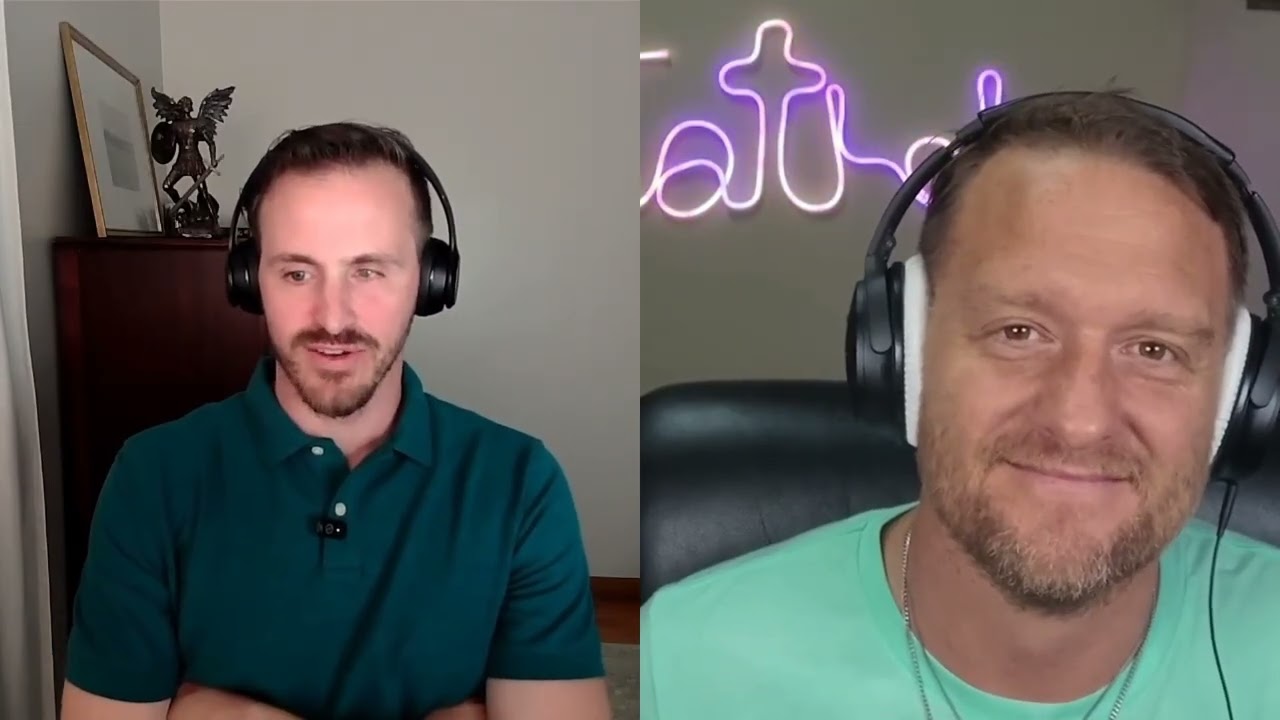


A host that leaps out of the ciborium and hits the ceiling. A stolen host that boils over with blood the moment it hits a pan. A doubting priest who watches the Body of Christ turn to bleeding human tissue in his own hands. These aren't legends but documented, forensically studied Eucharistic miracles, and Shaun McAfee just spent a year and a half compiling the most thorough collection of them ever written.
Shaun is back on the show for round four, and this one will change how you walk up for Communion.
We get into how the Church actually investigates a miracle claim (it's closer to a forensic crime scene than you'd expect), the science behind Lanciano's bleeding, liquefying host, the story of a woman who stole a consecrated host to brew a love potion, and why reverence matters more than most men ever stop to think about.
🔑 KEY TAKEAWAY
Before your next Communion, stop and actually examine your conscience first. Shaun lays it out plain: how you approach the Eucharist says something about whether you understand what you're receiving.
Treat that walk up the aisle like it's the most important thing you'll do all week. Because it is.
💬 QUOTES WORTH REMEMBERING
"A miracle only exists to draw us closer to Him."
"This is the most important thing we do in our lives — to receive Him."
"Sometimes God gives us miracles He asks us to keep in the silence of our heart."
📚 MENTIONED IN THIS EPISODE
- Compendium of Eucharistic Miracles by Shaun McAfee --> USE CODE MANLYCATHOLIC TO SUPPORT THE PODCAST AND GET A SPECIAL DISCOUNT CODE
- Shaun McAfee personal website
- RealPresence.org — Eucharistic miracle archive inspired by Bl. Carlo Acutis
Thank you for your prayers and support!
Consider supporting the podcast on our Buy Me A Coffee page to help grow the show to reach as many men as possible!
Subscribe to our YouTube page
Check out our website
Buy coffee from Mystic Monk Coffee
Download TAN Digital to access the incredible TAN Library! Use code 'MANLYCATHOLIC' to get 50% OFF your subscription!
Contact us at themanlycatholic@gmail.com
James Caldwell: This is the Manly Catholic, the podcast that calls you out of the shadows and into the fight. Here we forge men into warriors for Christ, husbands, fathers, and leaders who refuse to kneel to the modern world's lies. No more passivity, no more excuses, no more lukewarm faith. This is your battle cry, your call to arms. The time for weakness is over. It's time to fight. Welcome to the Manly Catholic. Let's get to work. hello all. Welcome back to another episode of the Manly Catholic. This is James, your host, and with me we have or welcoming back Sean McAfee. Sean, welcome to the Manly Catholic podcast. Thank you. Number four. Number four. I was telling Sean, I think we might have to do like medal for all the guests who get there for five times. So Sean, you have to one more time, my friend. I got a feeling it's gonna happen soon. I make a make a make believe metal. So I might be wearing the same shirt. Hey, me too. Because we shine. It really brings out our complexion when we when we wear these shirts. So yeah. But hey, tonight we're talking about another book that Sean has written. Sean, you just can't stop just printing these things, huh? Compendions of Eucharistic Miracles. I make sure are you sure? Are you sure? You know, it's fun whenever it's it's come a long way. You know, I I got really lucky with my first book, Filling Our Father's House. That was back in twenty fifteen. And I was just shocked that Sophia Press took that on. I only had to ask once. And then, you know, I had to propose the next several books. I did self publish or kind of went through a, you know, a smaller publisher for for one or two. And then and then I had to propose and kind of fight fight my way through the proposal phase and but after now plus ten books, what, twelve, thirteen books, you know, I'll I'll say this and it's a little bit of a I feel braggadocious, but the the You get what you want. The yeah, the publisher asked me to do this and whenever I put pitch a book, you know, they they allow me to go for it, you know, so long as it makes sense. Right that's a big that's a big that's a big step. sure. And I don't I don't overlook that. I'm very grateful for it. all the books, it's it's been good. It's exhausting. It's taxing. It takes away from the family. and it's a work of love. You don't ever get your money back. You put tens and tens and hundreds of hours into these. And anyways, listen to me. I'm grateful. Let me list all my complaints about it, but I am grateful. I like that. It's tough. It's tough. But I can imagine. It's a privilege. Yeah. Well a hundred percent. Well, let me give you a proper intro here for those who have not listened to the a hundred other times you've been on the show. But Sean McAfee is a Catholic convert and a lay Dominican with the central province of Saint Albert the Great, a veteran of the US Air Force, which I don't think I knew that. So thank you for your service, by the way. He holds a Master of Business Administration from Liberty University and a Master of Dogmatic Theology from Holy Apostles College and Seminary. He currently lives in New Orleans, Louisiana with his wife, Jessica, and their seven kids. And he has written twelve or thirteen, maybe fourteen books. We've lost count. But Sean, it's it's always a pleasure, privilege, and honor to have you on. But before we dive into this wonderful work of art that you put together, let's do the St. Michael prayer, shall we? Amen. Father, Son, and the Holy Spirit, Amen. Say Michael the Archangel, defend us in battle. Be our protection against the wickedness and snares of the devil. May God rebuke him, we humbly pray, and do thou prince of the heavenly host, by the power of God cast into the house of Satan and all the evil spirits abroad about the world, seeking the ruin of souls. Amen. And Father Son. And the Holy Spirit. Amen. I think I I think I asked you this last time we did one of your compendiums here. I mean, the Eucharist, especially, because this isn't just I mean, it's those compendium Eucharistic miracles is the title of it, but you go much deeper than that, which I actually was not expecting when I first got it. I thought you were just gonna dive right into the the Eucharistic miracle. So but I love that you did that because it if there's I mean, as we know, being Catholic, it there's so much rich tradition. And theology behind it and so much meaning behind it. So I guess for you, what was the how do you go about putting together a book like this? I mean, because there's just so much on the Eucharist, especially. So how did you kind of craft in your mind how you wanted to do that? There were a lot of there was a lot of reason to not just go straight for the miraculous stories. I didn't want to make a spectacle. I want to increase the faith of Catholics and I want to pull in non-Catholics. A non-Catholic might pick up this book. I mean, definitely will, like at a dentist's office or inherit it from their grandma, and they're going to be like, Really? There's a collection of miracles. Let me read about these. They're going to realize they're pretty credible. And then they're going to say, Okay, well I got to learn more about this Eucharist thing. And if I don't have that right there in the book explaining the whole thing, then I've lost an opportunity for a convert. and then like I said, you know, even for the Catholics out there who are believing, you know, we need to go over, you know, the the boundaries of heretical beliefs. A lot of people, you know, believe it or not, they they might go stretch a little far on some of the crude interpretations of what the real presence means. they also might stop short. so so it was really important. We spent the first 90 pages, I think, really talking about the typology from the old testament. All the way into the new where the multitude is grumbling and grieving over Christ's literal words. And we talk about the church fathers and all the heresies that built up our intellectual tradition with the Eucharist. And then of course the Eucharistic saints throughout the throughout the centuries. It was it was it was great. Those first ninety pages are really the most important. yeah, a hundred percent. And you know, I I I want to ask too, because you you you break down to obviously we know about the Eucharist, but even the term the a miracle. Right. So what exactly for our audience, just a working definition, what is a miracle? So a miracle is an event that supersedes the natural order. It's when God, we all we always attribute miracles to God because God is the only omnipotent creature. So God chooses to involve himself to alter like the physical world in order to do something radical. so so miracles have all kinds of all kinds of forms. Now God only performs miracles for three reasons. He does it either to confirm the sanctity of a person, a place, or a thing, like we see with Lord's and Saint Bernadette. first of all, the Lord's location being a sacred location. Number two, in that same example, that same refrain is the come confirmation of a specific teaching of the church. So, with the Lord's example, it would have like the new Immaculate Conception. Now we find the same thing in these Eucharistic miracles as Christ as light of the world, as the real presence of Christ in the Eucharist and so forth. even as the divine physician, we find these Eucharistic miracles going in that direction. And then of course the catch all is to increase our faith. God only performs a miracle in order to draw us closer to him. Yeah, that's and I know you I'm gonna define it too here according to Father Francis X Doyle. let's see. Or okay, sorry, I lost my train of thought here. Okay, here you go. Yes, a miracle is a sensible work, for example, is a work which can be perceived by the external senses as beyond the powers of nature. Either the work itself could never have been done by a natural force or the manner in which the work was done is beyond natural forces. And he goes on to frame it. The work can be attributed to God alone as principal cause. For example, ultimately as God alone who works the miracle by reason of his omnipotence, although he may use finite beings as instrumental causes. I like that. He may use finite beings as instrumental causes as well. So, you know, talk miracle in the Eucharist, obviously. So I want to dive into a little bit before we dive into maybe specific ones. Is how does the church go about? So say, you know, I say, hey. Sean, I think I have a a Eucharistic miracle occurred here. So what what does the church do? How does the investigative investigative process go? This is real, by the way. I I need to know Sean because I need to know the right steps here. So how does the church go about doing that? You don't have a miracle to investigate, do you? So the church so the church, first of all, goes full in. You know, this is the body of Christ. It's already a consecrated host. It it means something more than more than just a An ordinary object to us. So we treat it with a a lot of fidelity, especially when we believe that a miracle has occurred, because it says something about God and what he's trying to communicate to us. So, on a scientific point of view, we're talking about DNA analysis, if it's a blood miracle, we're looking at the overall composition of the, of the, of the host or of the wine. If it's a if it's not just a blood miracle, but maybe if it's like a like a There's miracles where these hosts have been miraculously preserved. So we want to see their state of decay compared to another source of that same timeline or or same circumstance and what it's been exposed to. they also do forensic studies. for famously they studied the the Lonciano host, which is known to liquefy. they did a DNA analysis. They believe that it came it came actually from multiple sources that it's resembles the heart of a mitochondrium, which is or I mean the the cellular tissue of a mitochondrium, which is a part of the heart and the ventricle where the blood comes in. and they they studied that, the forensics team studied that, you know, these are the people who are out looking for, you know, murderers and whatnot, and they're looking at, you know, what where where is the where has the body taken, you know, such a such a beating or had violence. And what they've seen is that that host in particular and others like that. have come back at like extremely distressed, like as if, you know, they had been beaten and worked over time. so we relate that to the passion. All other really important, you know, just as important as those physical things is they bring in theologians and they bring in investigators to, you know, to discern the eyewitness statements, to draw forth the full story, what happened, what was happening, and what's been said since. And then, of course, they look look at the theological side. You know, what was God trying to communicate? does everything that came from this miracle match up with you know sacred tradition, sacred scripture? and does anything, you know, stand in the way of somebody following this as you know, something to venerate? those are kind of the basics. There's a there's a whole flood of tests that come in to scrutinize this, but the bottom line is that you know the church takes an awful lot of fidelity when it comes to studying these. Not just because it wants to lose its re it doesn't want to lose its reputation, but because this already is something special. It is the it is the body of Christ. And so we need to treat it as such. Isn't it t true as well, Sean? Is is when say they're under investigation, that don't they basically send samples and to these scientists and they don't tell them like what it is really. It's just, hey, can you can you analyze? So they want to make it as impartial as possible. It's not like, hey. By the way, think a miracle is happening. Let's let's send this to a Catholic scientist. But they want they want to send to a skeptic almost, or someone who's like solely impartial, because again, none of this, you know, like, well, there's a biasy going on. So of course they're gonna contribute it to you know to this. And I I think I think maybe they don't look for skepticals or they maybe they don't look for atheists to do it, but it those those people so happen to be that. So what they're looking for is the experts, the utmost professionals in their field. So whether it's that forensics, forensics or whether it's that histographical, biological, you know, the stuff under a microscope. they're looking for the best in the field to be able to to investigate this. And then yeah, there's a lot of these miracles, especially in the twentieth, twenty first century that have been investigated where carte blanche, they're they're kind of throwing the team in a room and saying, Just tell us what you see. They're giving them basic details and not saying, Hey, we're investigating a miracle. You know, if you could home run this one for us, we'll have a new pilgrimage site. They they'd They leave it completely up to the auspices and the prerogatives of those professionals and they they accept what they they accept what the outcome of that. Yeah. Coffee and prayer. It's the perfect blend. Mystic Monk Coffee isn't just another cup of coffee. It's handcrafted by the Carmelite monks of Wyoming, roasted with care and infused with prayer. Whether you're starting your morning or fueling your day, Mystic Monk Coffee has you covered. It offers rich, bold flavors that are as divine as their mission. By choosing Mystic Monk, you're not just enjoying exceptional coffee, but you're supporting a community of monks dedicated to their work, to prayer, and to the church. It's coffee with a cause. So what are you waiting for? Visit Mystic Monk Coffee.com and experience the brew that's fueling faith and flavor. Yeah. No, correct me if I'm wrong. So there's over what, a hundred miracles that you included here. So I can count them by five. Okay. Okay. So how many did you investigate though? Because there's some that didn't make the cut. I mean, I don't know how many how many miracles have been confirmed by the church on the Eucharist. Do we do we have a number on that? Well, most equipment. Yeah, I I don't think there is a number. You know, you can probably do some basic internet searches. You can probably even go to RealPresence.com, which is a continuation of, you know, it's inspired by the work of Bless I was said blessed St. Carlo Acudis. And so that explores more than I think 150. It's somewhere in that ballpark Eucharistic miracles. And some of them just ha and I was warned about this before starting on the book from a rather well known miracleographer. That's what I'll call him, that that people know out there on from the radio and And other other broadcast series. They said that be careful with what you find on that website and within those materials, because some of it's really sketchy, some of it is just pious legend, and even the locals don't own it. So what was important to me in writing this book is you might go through the book and you'll see like parish websites. You might see like a diocesan website rather than some sort of, you know, scientific journal. Well, what was important to me was to tell the story from the people who have the the claim over these stories, who have ownership over over the details, you know, when did it happen? How did it come about? And what's the local version of that story? What's the local tradition? How is it celebrated? so going to those individual places virtually, some of them I have been to physically, just lucky enough to live in Europe, going to those places virtually and discovering their version of the events and and putting those in here. As long as they were owning it to a, you know, a healthy degree, it's kind of a little bit of a gut check. if as long as they were op holding it to a certain degree and I wasn't just finding it on this blog and that blog, the same copied and pasted story over and over, then I consider it to be somewhat credible. But the church, you know, the church over time has of course adapted, you know, taking taking taking ownership from the local bishops sometimes and placing it the hands of you know the different dicasteries over time that the Vatican has has presumed over or presided over, or they're you know leave it completely to the discretion of the bishop to you know affirm and confirm what's going on in that local diocese. So it's changed over time. Yeah, I just looked it up. So St. Carlo Acuda's cataloged 144 officially documented Eucharistic miracles. But there might be a few more. So like up to a hundred and fifty. Yeah. And you know what I always tell people is there might be thousands more that have happened that we just don't know about. I say that in the book. You know, sometimes God gives sometimes God gives us miracles that he asks us to keep in the silence of our heart. Absolutely. Absolutely. Amen. All right. So you said you went to some of these places. So you have some skin in the game, so to speak. Which which ones? You mind if we dive into those? Yeah, I've been to Bolsena. you'll find the Corporal of Bolsena. It's definitely one of the most famous Eucharistic miracles. You'll find that corporal, which is a altar cloth where the it it it sits below the chalice and the ciborium as the species are being consecrated. This is a story that took place in the twelve sixties, whenever the Pope was actually thirty miles away. Instead of being in Rome, he was thirty miles away in Orvieto. So this little Lakeside town called Bolsena, there's a doubting priest, St. Peter of Prague, and he famously, he famously is doubting as he's saying the words of consecration, the host begins to bleed in his hands and it the spots spots of blood drip all over this corporal. The Pope investigates. Saint Thomas Aquinas happens to be in town and writes some beautiful liturgy that we sing at every Eucharistic adoration and procession. And and the rest is history. I've been there. I have been to Salzano, which is another fun one. yeah. and and I happen to live close to some of these that I just didn't even know about. One of them was Ferrara. Ferrara's kind of a mid-sized town in northern Italy. And you it's normally one of these towns you gotta take an exit to go see. in there is a really fun Eucharistic miracle where a where a host leapt out of the ciborium and hit the ceiling. And and wow, there's there's stains and marks from from this event from the blood and the just the impact of the host hitting the ceiling. there's really fun things like that. I'd love to see them all. There's there's n there's no end to the to the wildness of some of these stories, and it'd be fun to go track track them all down. All right, what's the wildest one, Sean? I love this one. It's just crazy. But it's got a really poignant ending, and I try to kind of include that in the book. Is there's a story. I don't remember the town that it's in, but there's a story in Italy where this this witch, she's non-believing, but she's heard that you know Christ pours out his love for us in the Eucharist. And so she hears this from Sunday Mass and from Christians, and she decides, I want to make this gentleman fall in love with me. I'm gonna steal this host from a consecrated mass. And I'm gonna take it back with me. I'm gonna make a love potion. And this guy's gonna love me because this contains all the love of you know God. And she takes it back home, puts it into a pan, and immediately boils over with blood so much that it runs all over her floor and out the house. And she immediately repents and she converts, as do many people around her. Now, the fun thing about this, the way that I kind of put a twist on it, is it wasn't just a crazy freaky story. She wanted to make this gentleman fall in love with her through the use th through the manipulation of the sacred host, but God turned that into a way for him to draw her close and to close and in love with him through this story. just a fun one. Kind of freaky, kind of crazy. Imagine blood boiling out the front door. my gosh. Now is is Len Lanciano, is that the one where gosh. Yeah, that's the liquefying. Yeah, the liquid okay. That is definitely I'd say the most famous one. Yeah. Do you mind explain to our our listeners? Yeah, so about the year seven fifty, this is one of the oldest miracles. And I'll say it i you can if you categorize the the the blood miracles, then then this is probably the oldest one, although one predates it. But of the I'd say the modern you know, scientifically, you know, just the world knows about this. It's it's L'Anciano. So in the year seven hundred and fifty, during host, another dubious we call that doubting, another doubting priest, is consecrating the host and it begins to bleed, it liquefies and it turns into tissue in his hands. Now this is it's been preserved. It's been in Lonciano for the last thirteen hundred and fifty years. And this is one that's had scientific investigations from, like you mentioned before, from you know, people who had no idea what they were investigating, they go and find the same thing. It's had investigation in the nineteen sixties from the World Health Organization to to back up the findings of Dr. Edward Linol Linoli, who famously found that it was heart tissue and A B blood. and it's one that a lot of other Eucharistic miracles I'll say have kind of been benchmarked by because because what we find is like a lot of the same findings, the blood type, the same kind of scar tissue. the same kind of forensic analysis. this one captured a lot of that, a lot of that scientific data and others have kind of been, you know, ha had how do I say it? They've been benchmarked by it. You know, these are the standards, I suppose, that you know, that we want to reach for. these are the findings. So if you find have findings that are similar to these, you know, it's more or less kind of like you're on the right track. that and too with all these Eucharistic miracles as well it's it's just like the Marion apparitions. It's like it doesn't we're not required to believe them for our faith. Cause obviously like you said at the beginning too like when Mass occurs, I mean Eucharistic the the Eucharist itself is a miracle in itself. But it's like God is always dropping these little nuggets for us to just to kind of reinforce our faith and just really appreciate too everything that happens during Mass and in in the Catholic Church too. So for you, Sean, I'm sure, you know, more of a personal question. I know you're a convert as well, but did this going through this, I mean, you heard stories, researched it, visited some of these places, does it just kind of reinforce your own belief in the Eucharist? Not that you ever doubted, of course, but just like, yeah, this this is why I believe like this is awesome. I think intellectually, I think we all have doubts. I really do. You know, it's I'm pointing the finger at myself, but I'm a pretty ordinary person. And I I'll say that there are moments where I'm like, Man, is it really? a and and and I have those kinds of moments. there's fewer of those after seeing this. And this is the fun thing about these miracles is they don't they don't start and they don't they can continue the faith and they can build it, but they don't start the faith. That is a theological gift that's only given by God. You know, we just heard in the, you know, the The readings last Sunday, it's it's analogous to Peter in Matthew chapter sixteen, where he proclaims, you know, my Lord and or no, that's that's Saint Saint Thomas, where he proclaims, you know, that Jesus is the Son of God, that he's the Messiah. And he says, you know, this was not given to you by human human form. This is given to you by the Father. This was revealed to you. And the same thing, that's that's the theological gift of faith. So The faith that it takes to believe in the Eucharist first of all comes from God. And God gives us these because He knows that we're incarnational people. He made us that way. And we need forms around us from the wedding ring on our fingers to remind us of our sacrament to even these wonderful miracles to bring us in closer to that with him. So, yeah, of course, you know, writing this book gave me a much thorough understanding of the theology. of of the Eucharist and how we've treated it over time. But of course the the fascination of how God just continuously wants to make the most epic events in history, the most epic s phenomena and miracles that just defy defy our imagination in order to draw us in closer to something that defies our imagination. You know, it's a hard teaching as the multitude said in John chapter six. Yeah. Yeah. It's it's like God knows that we need it's almost like he knows that we need these sort of reinforcements time after time. Not that, you know, not that our faith wavers, but sometimes it's good, like I said, to have those little those little nuggets here and there once in a while and and just seeing God looking back and and seeing what he does for us day in and day out. I think it's it's always good to have. Yeah. So I was gonna ask you, cause you mentioned too, I mean we talked about obviously the the theology behind it, the Bible verses. I you talked too about I think for men this is especially important too just The cause I think in the just the reverence approaching it and really making sure that we are preparing ourselves in order to receive the Eucharist. I think unfortunately it's kind of gone off by the wayside where we're just kind of shellaced. I mean, I know I do as well. But just if you want whatever you want to speak on that, just the reverence that is required too, just like St. Paul says, you know, make sure we're examining ourselves because if we take the Eucharist in an unworthy manner, it's actually worse off and then we are committing a sin. So I just wanted to touch on that a little bit too because I know you mentioned that the book. Yeah, that's step one is to is to make sure you have a complete and thorough examin examination of conscience, you know, so that whenever you're approaching communion and not just to receive, but literally when you're approaching him, you know, this is still in canon law that even if you're under mortal sin, you should refrain from entering the line. That is in canon law. the God wants us to come to Him no matter what. He wants us, He wants to hear all of our sins and to forgive us. He wants us to receive this every day and as often as possible. so that that examination of conscience, making sure that we've we're free from sin, enables us to to be drawn in closer to him and to receive the graces that come through the sacrament. Of course, we want to study how we are receiving it, you know, physically, you know, what's our posture? Are we bowing reverently? are we, you know, stepping to the side and kind of having a a acute moment or are we, you know, receiving it with, you know, great reverence? there's many ways to receive. We can receive on the tongue, which I believe personally is probably the most profound and dignified way to rece to to receive. or you can receive in the palm of your hand, but you shouldn't be like holding one kid in one hand, receiving it in the other and kind of slapping it into your mouth. I've seen that just a dozen times and those are the moments where I'm like, Okay, Lord, I'm Obviously, obviously you're teaching me something here more than just reference for the for the Eucharist. You're talking to me about my you know judgment of others. But those are, you know, those are real things that people need to be aware of. How are we receiving it, you know, interiorly and then exteriorly? I think I just made those those words up, but you know, taking the whole taking the whole experience and the whole thing into con into consideration is is important. We shouldn't just do it blithily. You know, as if it's any other event. This is the most important thing that we do in our lives is to receive him. yeah. It's and and I I agree with you too. I I've been receiving on the tongue and on the knees as well. Yeah. I just for me it's it's a all th all other things aside, it's it's for me it's a sign of humility. You know, it's like I am I'm coming before you and I'm not worthy, but you make me worthy in order to receive you. You know, so that's that's why I do it. And again, You know, we can talk about, you know, of course it is allowed to receive in your hands, but like you said, it's it gets sloppy too quickly. in my opinion. And well said that you're yeah, it's it's again, y yes, it's allowed, but I think we we should go back to the more yeah, the more reverent because yeah, y you receive on the tongue and then yeah, it's it's in there because you know, I know other priests and people are in like the exorcism ministries to say as well, it's it's a It's has become an issue where people will put it taking their hand and then they won't actually put it in their mouth and then they go and do desecrate it unfortunately as well. So yeah, yeah. You know, it's it's I don't know. It's I know it's a it's a hot topic for a lot of Catholics and but I I think it's something too like you said, it just comes down to reverence. You know, what is the most reverent way for you to receive it? And you know, I I think that it's clear kind of what is what is the most practical and reverent way to receive it. But yeah, other people have other opinions, so we'll we'll leave it at that. Yeah. We'll leave it that. so I know we're in the middle of a Eucharistic revival as well. So I think this book is pretty spot on. did you have that in mind? w I guess how long did this book even take you to to put together? And then was that before the Eucharistic revival was announced or You just kinda had a premonition of what was gonna happen here, Sean. I think that I think that that Eucharistic congregation was last summer, right? so I was I was finishing this book after about a year and a half. And then and then we took the last really a year to compile all the imagery to to edit it to make sure it had the right theological tone and language in it. but I think it was fortuitous. I think it was fortuitous. I think that this book will stand for a long time as the most thorough the the the most honestly researched and compiled collection of these miracles and of course the presentation of the theology. I think that I think that grandmas will have their grandkids inherit this book one day and it'll be a a treasured piece. Amen. Well and you said too to have this in a dentist's office, if we could have this book and doctors and dentists office, I think America would be on the right track. Imagine that y you crack the book open while you're waiting and you're like, Hold on. Hold on. Sean, you you gave me an idea. Let's just buy a bunch of these and then we'll just go to all the businesses and just subtly, you know, put it on the put on their tables in there on the waiting room. Yeah. Yep. Maybe some miracles will happen there too. All right. All right, Sean, give us the final word. Anything else you want to speak about this? Where else can our listeners find you? Find more of your 13, 14 books that you're working on and probably five more. Yeah. well, you can find me at seanmacie.com. I'm not big on social media, although I do a lot on Instagram these days. so that's seanmacee.com. If you want this book, just go to tanbooks.com. There's usually a sale going on or wherever books are sold. Awesome. And I will leave. A link in the show notes for you guys as well. I'm trying to spell your name, Sean McAfee. There you are. I got it right. Alright, I'll leave a link in the show notes for you guys as well. And everyone, until next time, go out there and be a saint. Brothers, thank you so much for listening to this episode. If the shows add value to your life, I'm going to ask you to do three things. Share with a brother who needs it. Leave us a review. And finally support the show so we can keep fighting. Links are in the show notes. We'll see you next week.